
Revenue, Gross Margin and average allocated cost can hide where profit is really created and lost
Most companies do not really manage profitability. They manage revenue, gross margin, and reported net profit. That sounds like profitability management, but often it is not. Revenue tells you how big the business is. Gross margin tells you the rate of gross profit on that revenue. Reported profit tells you what is left after costs have been summarized, assigned, or allocated. All three are important, but none of them necessarily tells you where profit is actually being created or destroyed at the customer, product, order, channel, or segment level.
Revenue tells you size. Gross margin tells you rate. Reported profit gives you what left after total costs are subtracted. True profit contribution tells you where money is actually made or lost.
That distinction is not academic. A large customer with a good gross margin may be one of your best customers. It also may be consuming profit through small orders, special handling, expedited delivery, unusual terms, extra sales attention, returns, credits, service exceptions, or management time. Likewise, a customer with a lower gross margin percentage may look less attractive in a report but still be one of your biggest profit contributors if the revenue is large, the operating pattern is efficient, and the cost to serve is low. The usual measures are not wrong. They are incomplete. They can make leaders feel like they know where profit comes from when they really know where revenue, margin rate, and allocated costs come from.
The proxy view looks logical
Most businesses have a natural proxy for value: big revenue plus attractive gross margin equals a good customer, good product, or good segment. That view is logical. It is easy to explain, easy to report, and easy to manage. It is also often misleading, because gross margin percentage is a rate while profit contribution is an outcome. A high margin rate on a small revenue base may not matter very much. A lower margin rate on a large, efficient, easy-to-serve customer may matter a lot. A customer with decent gross margin can still destroy profit if the operating complexity is high enough.
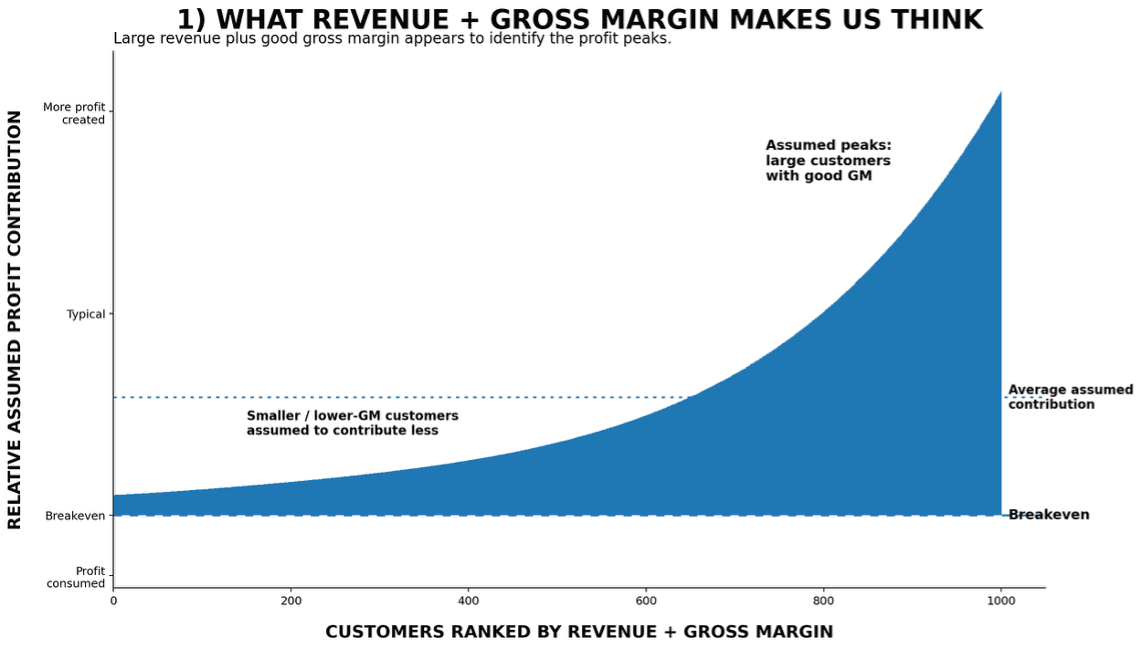
Figure 1. The common management proxy: large customers, high-margin products, or attractive segments appear to be the obvious profit peaks.
This is where the 80/20 rule is a better starting point than the average. Most executives understand 80/20 immediately: a small portion of the business usually drives a large portion of the result. But in profitability, the 80/20 pattern is often not obvious from revenue or gross margin. The question is not which customers have the highest gross margin percentage. The question is which customers create the most profit dollars. Those are most often not the same customers.
Across the businesses we have worked with over the last decade, we see a consistent pattern. A relatively small number of customers, products, orders, channels, or segments create a disproportionate amount of profit. A large middle contributes modestly. A smaller group consumes profit. And within that group, a few severe drains often create most of the damage. The real pattern is not simply good and bad. It is peaks, flats, and drains. Revenue and gross margin often do not show that shape.
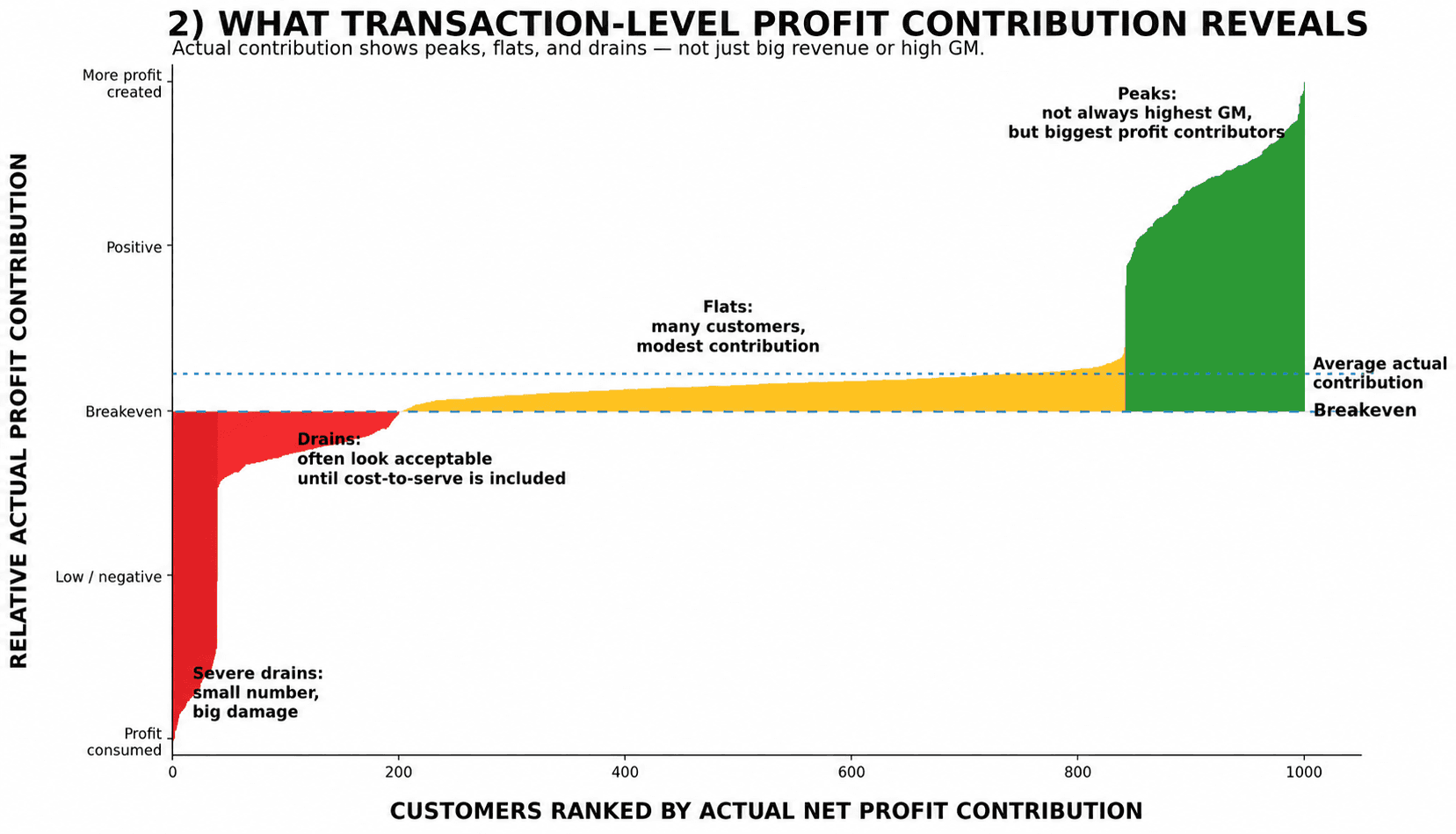
Figure 2. The transaction-level view: actual profit contribution reveals peaks, flats, and drains across customers, products, orders, channels, and segments.
Allocated profit can hide the truth
At this point, many executives will say, “We do look at net profit.” And they do. At the company level, division level, business unit level, or product family level, reported profit is visible. The issue is what happens when that profit is pushed down to customers, products, orders, or channels. In many companies, it is not truly measured. It is allocated. That distinction is critical.
Most companies take total costs and spread them across the business using simple rules: revenue share, gross margin percentage, standard cost rates, average freight, average labor, average overhead, average service cost, or broad allocation formulas. Those methods are necessary for financial reporting, but they are dangerous for managing profitability because they smooth out the very differences leaders need to see.
Averages do not reveal complexity. They hide it. The P&L can be right, and the operating conclusion can still be wrong.
Consider two customers that look similar, or even inverted, in a traditional report. The first customer has an attractive gross margin, so it appears to be a strong account. But it places many small orders, requires special packaging, needs split shipments across multiple locations, asks for expedited delivery, and creates extra manual work for sales, service, warehouse, and logistics teams. If those costs are spread across the customer base through average handling, average freight, or broad overhead allocations, the account may look profitable when it is actually a drain.
The second customer may have a lower gross margin rate, so it looks less attractive at first glance. But it orders in bulk, accepts unpackaged or standard-pack delivery, ships on predictable schedules, requires fewer touches, and fits the company’s operating model cleanly. Its gross margin percentage may be lower, but its true profit contribution may be much higher because the cost to serve is dramatically lower. In a broad allocation model, that customer can look ordinary, but in reality it may be one of the company’s true profit peaks. In both cases, the accounting may be accurate at the company level while the management signal is wrong at the decision level.
This is why reported profit can reinforce the same false confidence as gross margin. It appears more complete, but if it is built on averages and broad allocations, it still hides the real economics of the business. That is not bad accounting. Financial reporting has to close the books consistently, accurately, and on time. The problem comes when companies use accounting summaries to make operating decisions those summaries were never designed to support.
Businesses operate one order at a time
Businesses do not operate in averages. They operate one order and one line item at a time. Every line item has a customer, product, price, channel, delivery method, service expectation, payment pattern, and cost-to-serve profile. Every customer-product-order combination can behave differently. Some combinations create profit efficiently. Others create complexity that traditional reports do not fully assign.
True profit contribution requires a different approach: costs have to be dynamically assigned based on what actually happened - the order, the shipment, the service touch, the return, the credit, the exception, the payment pattern, and the operational work required. Once that happens, the shape of profit changes. Some customers that looked attractive become flats or drains. Some customers that looked ordinary become peaks. Some products, channels, or segments that looked profitable are revealed to be subsidized by others.
The management agenda changes
Once leaders can see true profit contribution, the goal is no longer simply to grow revenue. It is to grow the right revenue. The goal is no longer simply to improve gross margin. It is to improve profit contribution. This new perspective changes the pricing, service levels, sales coverage, order policies, channel strategy, and investment decisions the team makes. The goal is not to treat all customers, products, or channels equally. It is to understand which deserve investment, which need a different operating model, and which require changes in pricing, service, fulfillment, sales coverage, terms, or expectations.
The issue is not whether a customer, product, or channel has revenue or gross margin. The issue is whether it earns its place in the business through its true profit contribution.
For the peaks, the question is how to protect and grow them. For the flats, the question is whether they can be moved up or served more efficiently. For the drains, the question is whether they can be fixed, repriced, redesigned, or whether the company should stop accepting business that does not make economic sense. That last question is hard. Companies do not like saying no to revenue. But once the true economics are visible, the issue is no longer whether the business has revenue or gross margin. The issue is whether it earns its place.
Profit has a shape. It is concentrated, uneven, and almost always different from what revenue and gross margin suggest. The P&L already tells you whether the company is profitable. The harder question, and the more useful one, is where profit is actually being created, where it is being diluted, and where it is being quietly given back.
Getting started
A useful starting point is simple: pull a sample from your bottom quartile of customers by revenue and look at their actual order economics. For each ask: How often do they order? What does a typical shipment cost to fulfill? How much sales and service time do they consume? In most companies, that exercise alone will surface customers whose true cost to serve exceeds what the margin report suggests; and a smaller number whose economics are far better than they appear.
That is not a full profitability transformation. It is a first look at the shape. And for most leadership teams, the shape is surprising enough to change the conversation.